
Condition precedent time bars: how one late notice kills a good claim
A condition precedent time bar turns a notice into a gate: if you don't give it inside the contract's window, often three to five business days, the entitlement never exists. The claim fails even when everyone agrees the work was extra or the delay was real.
Chapter 2: Two words that kill more claims than bad work ever will
Somewhere in your subcontract is a sentence that says, in effect, tell the builder about something one day late and you'll never be paid for it. It won't say it that plainly. It'll say "condition precedent" or "bar and invalidate". Under an ordinary notice clause, a late notice only lets the builder reduce your claim by whatever the lateness actually cost them. Under a condition precedent, the claim never existed. When the book was written (Sept 2026), all 50 of the 50 readable time bars in the Australian Subcontract Index were drafted this way.
The windows are short and there are plenty of them: three business days for a first delay notice or a latent condition, five for a variation, an extension of time or disputing a short certificate, and often a second, detailed delay notice on top. Put those on a real week with a pour, a public holiday and a busy estimator and they expire before anyone thinks of them as paperwork. A $30,000 variation everyone agrees was extra dies because the email arrived on day six, and the rejection is two lines long. On the builder's side, I wrote that email myself.
The fix is a habit, not a lawyer: a four-line email the same day, confirming the instruction and saying you consider it a variation. In negotiation, don't ask to scrap notices. Ask that late notice only reduces a claim by the prejudice the builder can show, with ten business days and the clock starting when your representative actually knew.
- 1When the book was written (Sept 2026), 50 of 50 readable time bars in the Index were conditions precedent; none used a plain notice requirement.
- 2Typical windows are three business days for delay and latent conditions, and five for variations and extensions of time.
- 3Wording like "should reasonably have become aware" starts the clock when anyone in your business could have known, not when the director found out.
- 4In my experience, a subbie with no notice system loses one to three per cent of contract value to time bars over the life of a job.
Search your current subcontract for "condition precedent", "bar", "invalidate" and "no claim". List each one with its window in business days. Give the list to your foreman with one rule: if anything changes on site, the office hears about it the same day.
Common questions
What is a condition precedent in a subcontract?
It's a step you must complete, in a set way and by a set time, before an entitlement exists. In notice clauses it generally means a late notice wipes out the claim entirely rather than just reducing it. These clauses are often enforced as written, so read the notice clauses before you sign and diarise every window.
Can a builder reject a variation because the notice was late?
If the contract makes notice a condition precedent, generally yes, even when the work was clearly extra. That's why it pays to send written notice the same day, and to negotiate wording that limits the builder's remedy for late notice to any prejudice it actually suffered. Get advice on your specific contract.
Free guides on this topic
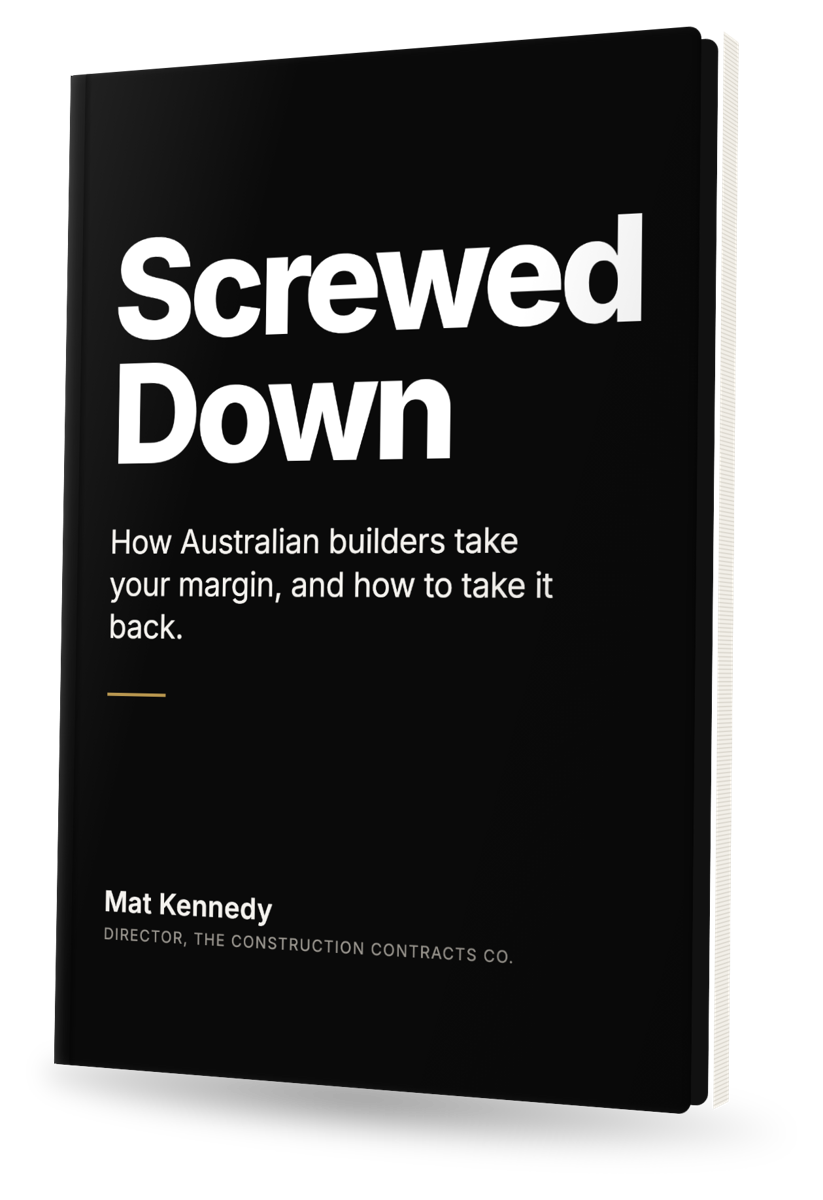
A summary of chapter 2 of Screwed Down by Mat Kennedy. Index figures are as they stood when the book was written (Sept 2026); the live numbers are on the Index. Amazon ranking as seen in September 2026. General information, not legal advice.