
Builder paying late? Why subcontractors end up as the builder's bank
Slow payment isn't bad luck, it's how the contract is built. Payment terms, retention and unclaimed variations together mean a subbie on a $500,000 package can be carrying $85,000 to $120,000 of the builder's cash at any moment, at zero interest and with no security.
Chapter 1: You are the builder's bank, and the interest rate is zero
Most subbies treat late payment like the weather: annoying, normal, something you wait out. This chapter argues it's neither. It's a system, and it runs exactly as designed. Take an ordinary $500,000 package over twelve months. Claim monthly on 30-day terms from the end of the month and there are about sixty days between doing the work and holding the money, so roughly $60,000 of yours is always sitting in the builder's account. Add $25,000 of retention and whatever variations never got claimed, and you're lending the builder somewhere between $85,000 and $120,000, interest free, unsecured, to a company you never credit-checked.
I spent four years in a builder's contracts office administering these clauses: applying time bars, certifying claims short at month end, holding retention because nobody asked for it back. None of it felt like villainy. Every clause looks normal on its own, and that's the trap. When the book was written (Sept 2026), the Australian Subcontract Index held 69 contracts across six states, and the harsh clauses weren't the aggressive end of the market. They were the market.
The other half of the chapter is the good news. The subbies who get paid on time aren't the ones with the best relationships. They're the ones whose paperwork makes paying them the easy option. A builder once ignored a $185,000 claim I served. Under the Queensland Act that silence turned the full amount into a debt due, and we were paid in full.
- 1On a $500,000 package claiming about $42,000 a month, around $60,000 of your money sits in the builder's account at any time just from the payment cycle.
- 2In the first half of 2025, construction companies reporting to the Payment Times Regulator offered small suppliers an average 33-day term and took 60 days to pay 95 per cent of invoices.
- 3When the book was written (Sept 2026), 50 of 50 readable time bars in the Index killed a late claim outright, and 57 of 58 contracts allowed set-off without notice.
- 4Every state's security of payment Act protects subbies, but most of what it gives you only switches on when you do the paperwork.
Pick your biggest current job. Add up claims submitted but not yet paid, retention held and your honest guess at unclaimed variations. That total is the loan you're giving the builder. Now write down the interest rate on it. That's the number to change.
Common questions
Is it normal for builders to pay subcontractors late?
It's common, but common isn't the same as lawful. Every state has a security of payment Act that limits payment times and gives you rights when a claim goes unpaid. Those rights generally only work if you serve a proper payment claim and track the deadlines, so check your state's Act and diarise every date.
How much money is a subcontractor really lending the builder?
Add up claims submitted and not yet paid, retention held and variations you never claimed. On an ordinary $500,000 package, the book works this out at somewhere between $85,000 and $120,000 at any given moment, generally at zero interest and with no security over the builder's assets.
Free guides on this topic
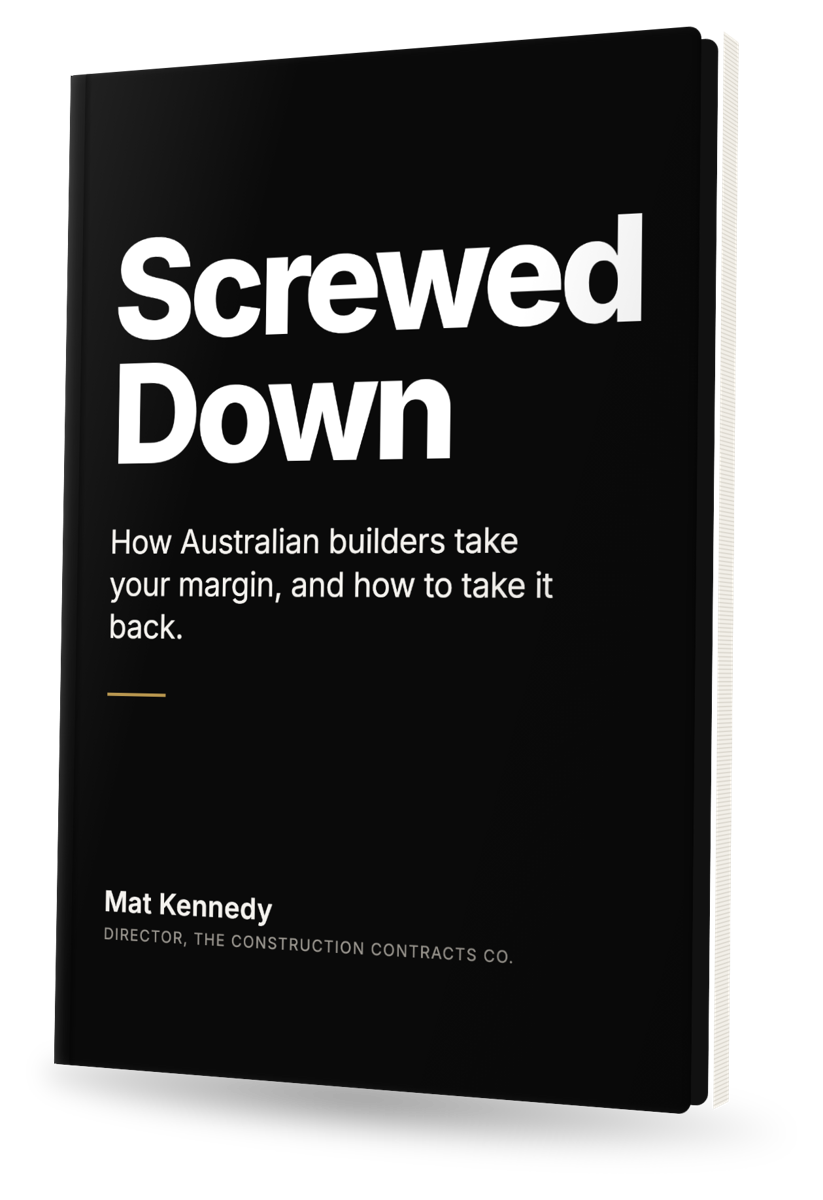
A summary of chapter 1 of Screwed Down by Mat Kennedy. Index figures are as they stood when the book was written (Sept 2026); the live numbers are on the Index. Amazon ranking as seen in September 2026. General information, not legal advice.