
Suspending work for non-payment: how subcontractors down tools legally
Every security of payment Act lets a subcontractor suspend work after written notice if a claimed, scheduled or adjudicated amount isn't paid by the due date. In several states, including New South Wales and Queensland, the notice is two business days; check your state's Act for its period. A proper suspension isn't a breach, and the builder carries the cost.
Chapter 19: Down tools, legally
When asking nicely has stopped working, most subbies either keep working and hoping, which is how unsecured creditors are made, or walk off in a temper, which is a breach and hands the builder a delay claim. There's a third way the law built for you, with three tools used in order: suspension, adjudication and enforcement. I call the first one the statutory stand-down. You serve a one-page notice in the Act's form, and if you're still not paid, the crew stands down on the builder's account. In my experience it ends most non-payment within 48 hours.
Two rules: serve the notice exactly as the Act requires, and go back as soon as you're paid. If suspension doesn't work, adjudication is a fast, paper-based decision by an independent adjudicator, who can only consider the reasons in the builder's payment schedule. Send a letter of intent first, and watch for the second-chance notice some states require. If the builder ignores the determination, file it as a judgment, and a statutory demand gives a company 21 days to pay before it's presumed insolvent.
The chapter finishes on litigation. I sat through a failed mediation on the builder's side, and later ran a claim of my own without a lawyer, and both taught the same lesson: in this industry a lawsuit is a contest over who loses less. The Act exists so subbies almost never need one. Use it first, use it early, and use it properly.
- 1A valid suspension under the Act isn't a breach, and the builder is liable for your costs of it.
- 2The suspension notice period is two business days in several states, including New South Wales and Queensland.
- 3An adjudicator can only consider the reasons in the builder's payment schedule: no schedule, no reasons.
- 4An unpaid adjudication certificate can be filed as a judgment, and a statutory demand gives a company 21 days to pay.
Find the suspension section of your state's Act and read it; it's about a page. Draft the notice with blanks for the claim, the amount, the due date and the section, and file it with your other templates. You'll probably never send it, and the builder never needs to know that.
Common questions
Can a subcontractor stop work if the builder doesn't pay?
Generally yes, under your state's security of payment Act, but only by following it. If a claimed, scheduled or adjudicated amount isn't paid by the due date, you can usually suspend after giving written notice in the required form. Walking off without the proper notice can be a breach, so check your state's Act first.
What happens if a builder doesn't pay an adjudication determination?
Generally the adjudication certificate can be filed in court as a judgment debt without a new hearing on the merits. From there, normal debt enforcement applies, including a statutory demand against a company, which gives it 21 days to pay or apply to set it aside. Enforcement steps beyond that usually need a lawyer.
Free guides on this topic
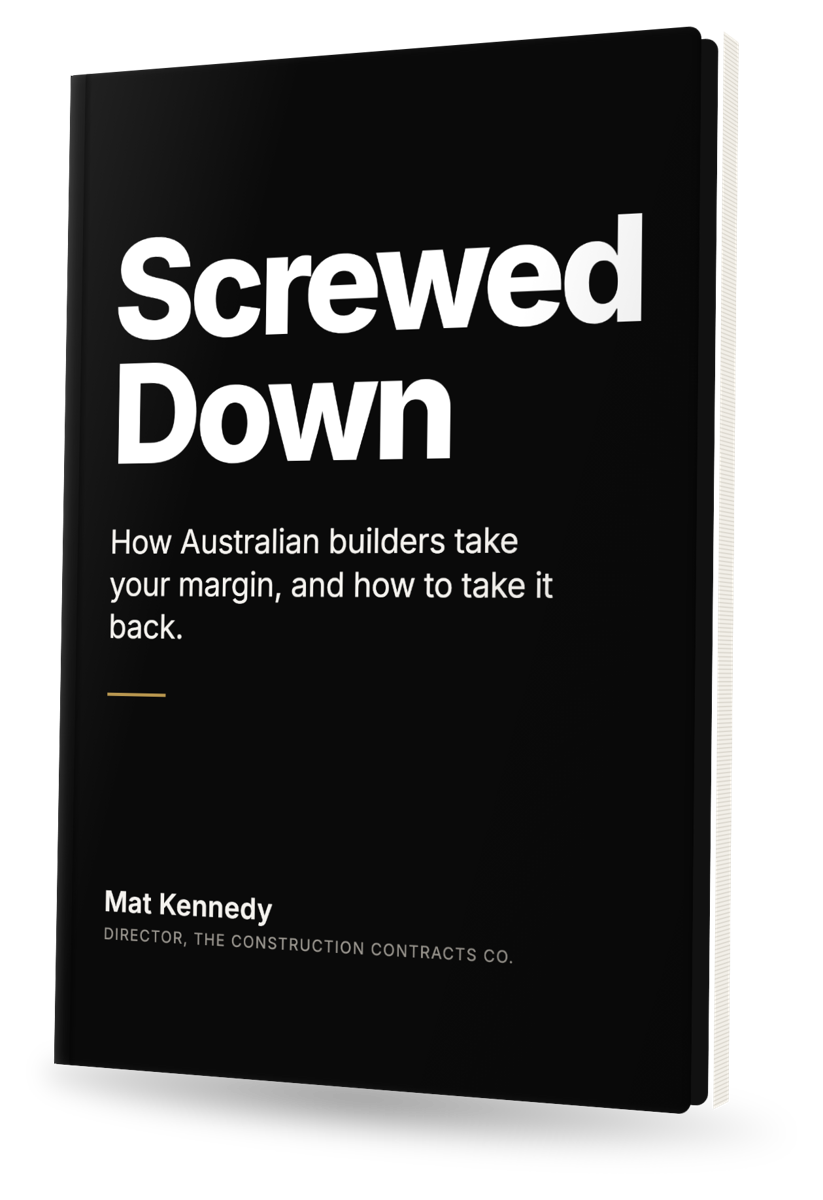
A summary of chapter 19 of Screwed Down by Mat Kennedy. Index figures are as they stood when the book was written (Sept 2026); the live numbers are on the Index. Amazon ranking as seen in September 2026. General information, not legal advice.