
No payment schedule? Why a builder's silence makes your claim a debt due
Under Australia's security of payment Acts, if the builder doesn't serve a payment schedule in time (in New South Wales 10 business days, or less if the contract says so; in Queensland 15), the full claimed amount becomes a debt due and the builder can't raise reasons for not paying at adjudication.
Chapter 18: Silence is a debt due
Every state and territory has a law whose whole purpose is getting subbies paid. It overrides the contract, it's fast and cheap, and it's built to be used without a lawyer. Strip it back and it's a timetable with consequences. You serve a payment claim, endorsed as the Act requires. The builder has a fixed number of business days to answer with a payment schedule: 10 in New South Wales, or the contract's period if shorter, and 15 in Queensland and Western Australia. The builder pays in full, schedules less with reasons, or says nothing.
Saying nothing is the one that matters. If no schedule arrives in time, the full claimed amount becomes a debt due, and the builder can't raise any reason for not paying that it didn't put in a schedule. That's what happened to the $185,000 claim from chapter 1: we were paid in full, with interest. It's why builders' contracts teams serve a schedule on every claim. The most valuable habit in the book is diarising the schedule date and sending one line the day it's missed.
There's a trap inside the gift. In some states, New South Wales and the ACT among them, you must first give a second-chance notice inside a set window before you can apply for adjudication. Miss it or apply early and the claim is dismissed on a procedural point. The Act also gives you interest, the right to suspend and debt recovery, but it won't revive a time-barred variation or save you from an insolvent builder.
- 1No payment schedule in time generally means the full claim is a debt due, and the builder can't raise new reasons at adjudication.
- 2Payment schedule periods: 10 business days in New South Wales (or less under the contract), and 15 in Queensland and Western Australia.
- 3Some states, including New South Wales and the ACT, require a second-chance notice before adjudication where no schedule was served.
- 4The Act won't revive a claim lost to a contractual time bar, release retention early or override a deed of release you've signed.
Look up three numbers for your state: the business days the builder has to serve a payment schedule, the days after the due date for any second-chance notice, and the adjudication application window. Write them above the desk where claims are done, then work out the dates each would have fallen on for your last claim.
Common questions
What happens if a builder doesn't provide a payment schedule?
Under the security of payment Acts, if a valid payment claim isn't answered with a payment schedule in time, the claimed amount generally becomes payable in full and the builder loses the right to raise reasons at adjudication. Some states require a further notice before you can adjudicate, so check your state's Act and deadlines.
How long does a builder have to respond to a payment claim?
It depends on the state. In New South Wales it's generally 10 business days, or less if the contract says so, and in Queensland and Western Australia it's 15 business days. Other states differ, and the exact period and any contract interaction are set by each Act, so check your state's Act for the current timeframe.
Free guides on this topic
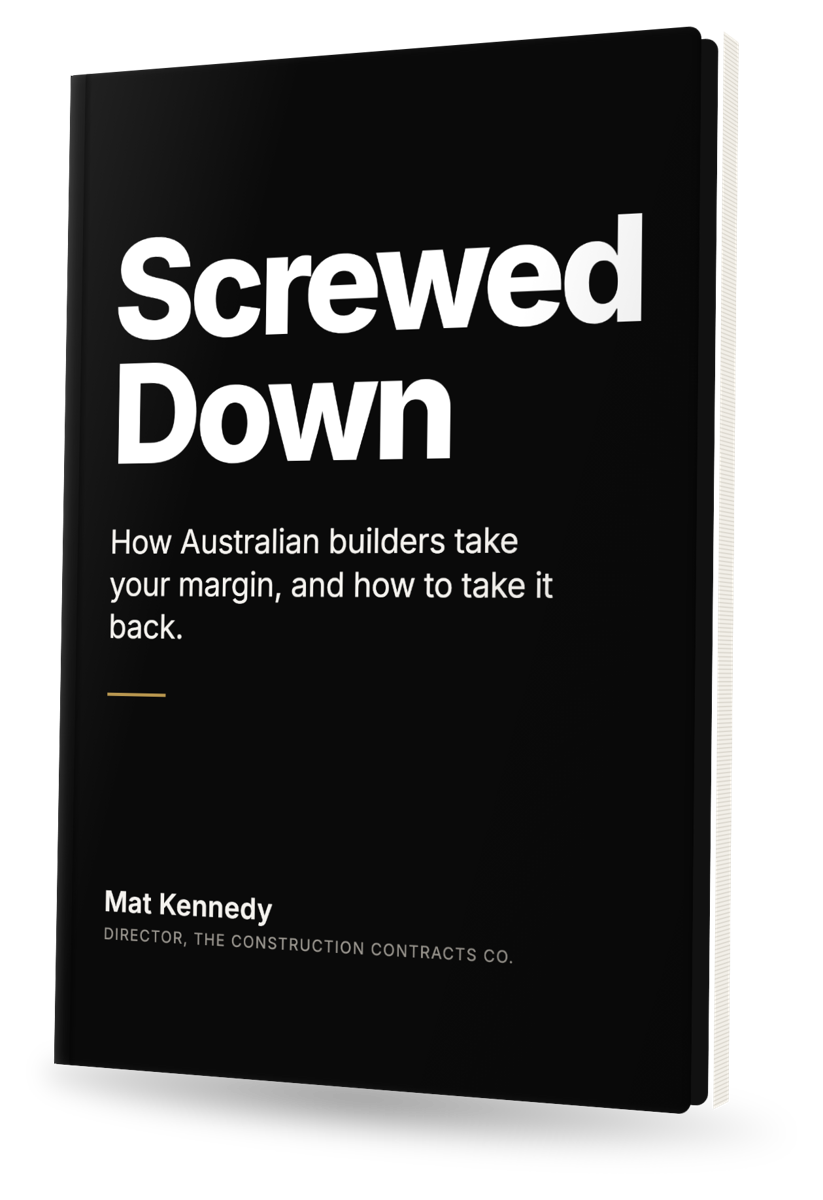
A summary of chapter 18 of Screwed Down by Mat Kennedy. Index figures are as they stood when the book was written (Sept 2026); the live numbers are on the Index. Amazon ranking as seen in September 2026. General information, not legal advice.