TCCC
The Construction Contracts Co.
Sample report
Scan yours free

What the scanner tells you, on a real contract.

A Queensland builder's major works subcontract, 64 pages, scanned on 29 September 2026. No names appear in any report. Everything below is what you'd see for your own contract, about two minutes after you upload it.

The questions it answers
  • Will I get paid on time, and is what they're asking even lawful?
  • What does a week late actually cost me, against my margin?
  • What can the builder take off my claim, and do they have to tell me first?
  • What do I lose if I miss a notice, and how many days do I get?
  • Sign it, push back, or walk?
Overall risk
9/10
CRITICAL RISK
Against QLD security of payment law and the subcontracts we've analysed.

The bottom line

Don't sign this as drafted. The payment timing is fine, but uncapped LDs with a head contract flowdown, 2 day EOT bars, open-ended set-off and a personal director guarantee add up to a package that can sink a small business on one bad job.

Get the LD rate filled and capped, the payment claim conditions and personal guarantee removed, and the time bars pushed to 5 to 10 business days. If the builder won't move on those, price the risk heavily or walk.

Where the risk sits
Payment & BIF Act compliance
How long until you're paid, and whether it's lawful
8/10
Liquidated damages exposure
What late completion costs you, and whether it's capped
9/10
Set-off & back-charge
What the builder can deduct, and whether they must tell you first
9/10
Time bars & EOT
How fast you must notify, and what you lose if you don't
9/10
Termination & suspension
How easily the job can be stopped, and what you're paid if it is
7/10
Indemnity & insurance
What you're on the hook for, and what insurance must cover
9/10

The three clauses to deal with before you sign

Ranked by what they could cost you

What it says
You are deemed to have "elected not to submit" a payment claim if it is late or fails any cl 12.2 requirement. Those requirements include valuing against the sum breakdown, a stat dec, insurance evidence, proof you've paid everyone to the builder's satisfaction, and having "remedied any breach". Clause 12.13 then says no payment is owed until warranty deeds, guarantees and releases are handed over and every breach is fixed.
Why it matters
Under the BIF Act, a claim that identifies the work and the amount, made from a reference date, is valid. Contract conditions that knock it out or hold payment hostage sit at the edge of BIF Act compliance, and the Act can't be contracted out of. The commercial effect is the real problem. If you believe the contract, you'll hold claims back or fail to chase a missed payment schedule, and you lose the full-amount lever the Act gives you. Clause 13.4 also gives you only 5 business days to claim after termination, which clashes with the 10 business days in cl 12.3(a)(iv).
What to ask for
Delete cl 12.3(b), 12.3(c) and 12.2(a)(xiv), and move the documentary items to "supporting information, not a condition of validity". Strike "has remedied any breach" from cl 12.13(g). Align cl 13.4 with the statutory position, and at minimum with the 10 business days in cl 12.3(a)(iv). Whatever the contract says, submit every claim on time and treat any missed payment schedule as your trigger.
Go deeper: Chapter 1 of Screwed Down, You are the builder's bank, and the interest rate is zero →

What it says
Item 9 leaves the daily LD rate blank. Clause 9.2(a)(ii) offers the builder its overheads "and any other loss" as an alternative to LDs, and cl 9.2(c) makes you indemnify the builder for head contract LDs "or any other damages" if you are late or breach anything. Clause 9.2(d) falls back to general damages if the LDs are struck down, and cl 3.13(b) carves delay damages out of the consequential loss exclusion.
Why it matters
None of these delay mechanisms has a cap. Uncapped LDs are common, since 81% of LD clauses in the contracts we've analysed had no cap identified, but that makes them market practice, not safe. The flowdown in cl 9.2(c) is the bigger threat. Head contract LDs are sized to the whole project, so a few days' slippage on your package could exceed your subcontract sum. Because there's no rate yet, the contracts we've analysed can't tell you where your figure will land. For context, the median was $1,500/day, and the benchmark for mid-size commercial work is $1,500 to $2,500/day.
What to ask for
Get item 9 filled with a fixed daily rate in the $1,500 to $2,500 range. Make LDs the sole remedy for delay by deleting cl 9.2(a)(ii) and 9.2(d), and cap total delay liability at 10% of the subcontract sum. Delete cl 9.2(c), or cap it inside that same 10% and limit it to delay caused solely by you.
Go deeper: Chapter 3 of Screwed Down, One late week costs more than your margin →

What it says
You must notify a delay within 2 business days of when you became aware, "or should reasonably have" become aware. A full EOT claim with critical path analysis is also due within 2 business days of the delay occurring. Missing either kills the EOT under cl 10.6. Clause 10.4 makes an EOT your only remedy for any delay, including delay caused by the builder's own breach, and cl 10.2A strips the EOT wherever delays are concurrent.
Why it matters
A 2 day window sits at the 25th percentile of the contracts we've analysed, so it's tighter than roughly three quarters of them, and under 5 business days is high risk on any benchmark. An absolute bar showed up in every contract we've analysed with a time bar. Paired with a 2 day critical path claim and zero delay costs, though, it means you carry prolongation cost even when the builder is at fault. Miss the notice and you also wear the LDs.
What to ask for
Push for notice within 5 business days and a detailed claim within 10 business days. Replace the bar with a reduction for prejudice actually suffered. Add delay costs for delays caused by the builder, the principal or separate contractors, and delete cl 10.2A or make concurrency apportion time rather than remove it.
Go deeper: Chapter 2 of Screwed Down, Two words that kill more claims than bad work ever will →
Set-off and recourse to security
cl 12.11 and 2.2
The builder can deduct or call on security for any debt, any claim it "might in the future have", debts under other contracts, or anything it thinks you "may in the future" be liable for, based on its own opinion, with no notice. Set-off without notice appeared in 97% of the contracts we've analysed, but this version is wider than most. Push for 5 business days' written notice, substantiation, and a limit to amounts actually due under this subcontract.
Retention and the rolling DLP
cl 2.1, 2.3, 9.5, 9.6
The 5% cap matches the market median in the contracts we've analysed. The 10% deduction rate is steep, though, and half is only released at practical completion of the whole head contract, not your completion. The balance waits for the "last" DLP. The DLP runs to the end of the head contract DLP, and each rectified item gets a fresh DLP, so your final retention can be held until the latest rectified item's DLP expires. Tie release to your own completion and a fixed 12 month DLP, with only item-specific security held beyond that.
Retention trust and security conversion
SC6 and cl 2.3(c)
Interest on trust-held retention goes to the builder. The builder can also convert bank guarantees to cash "at any time", and you give up the right to seek an injunction to stop it. Limit conversion to amounts due after notice, and strike the injunction waiver.
Execution page and cl 17.16: Automatic personal guarantee
Signing as a director personally counts as agreeing to give an unconditional guarantee and indemnity for all the company's obligations. This puts your house behind an uncapped contract. Refuse it, or cap it at a fixed dollar figure with a sunset date.
Indemnity and proportionate liability
cl 3.1, 1.14(c), 5.3
The indemnity covers "claims by any person" and any breach, not just your negligence. It extends to the principal, and proportionate liability is excluded, so you can wear losses others contributed to. Limit it to loss caused by your negligence or breach, reduced proportionately for contribution by the builder and others.
Other time bars
cl 10.1(a), 11.1(b), 11.5, 14.1 to 14.3, 1.7(a)
Variation claims have a 5 business day window, which matches the median in the contracts we've analysed. General claims need notice within 5 business days plus a detailed claim 5 business days later, and document discrepancies must be notified within 1 business day. All are hard bars. Seek 10 business days and prejudice-based consequences.
Rolling and final releases
Schedule 1 item 4, cl 12.7, 12.8, Schedule 3
Every stat dec releases any claim not already notified. Completion and final release deeds, plus the final certificate, wipe out everything not specifically listed. Strike item 4, and carve out all claims already included in payment claims or disputes.
Risk transfers with No Claim
cl 1.3, 1.6A, 1.7(c), 6.1, 17.4(b)
You get no claim for late site access, inferred scope, latent site conditions or changes in law, and cl 12.1(b) rules out rise and fall. Price these risks in, or get access delay and change in law treated as variations or EOT events.
Suspension and step-in
cl 8.3 and 13.1(d)
The builder can suspend for any reason. You get an EOT but no costs, and after 3 months the builder can terminate. On default termination it can take your plant without compensation, backed by a PPSA security interest under cl 17.13. Seek suspension costs, and limit plant seizure to what is paid for.
Insurance excess and platform fees
cl 3.2(b) and 12A
You pay the builder's $10,000 works insurance excess where loss is caused "directly or indirectly" by you. You also pay subscription charges for the claims and document systems. Limit the excess to loss caused by your negligence, and push platform fees back to the builder.

What this contract could cost you

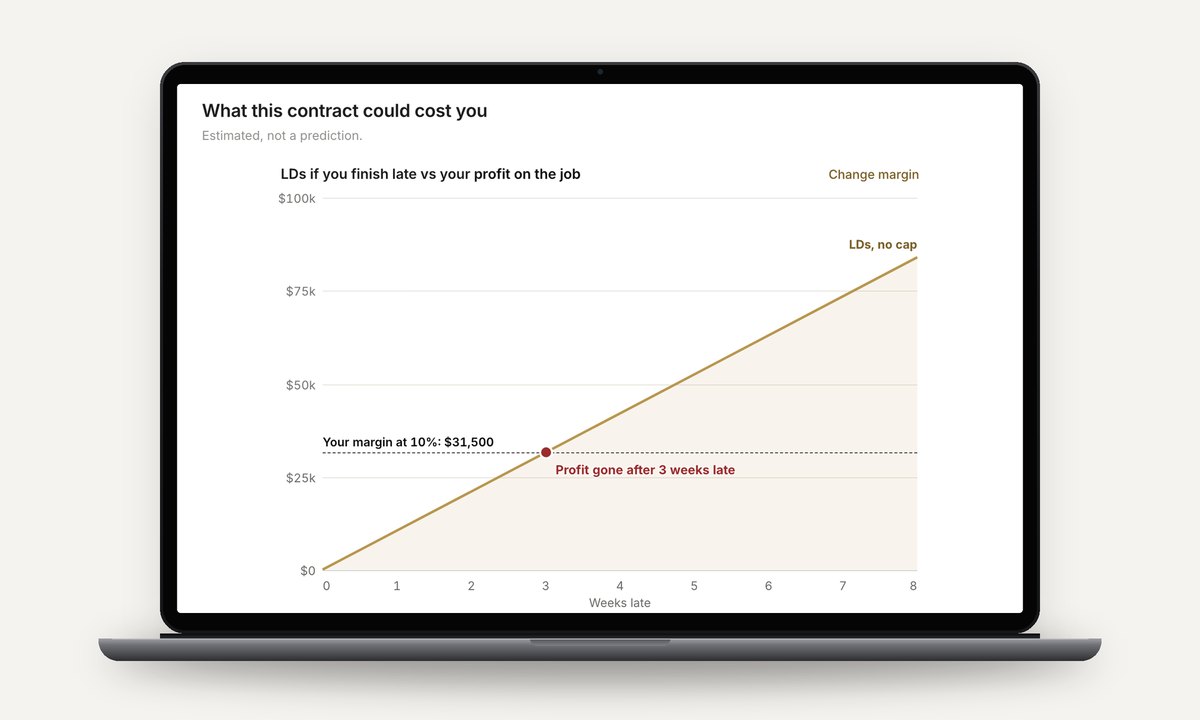
This template leaves the daily rate and the contract sum blank, so there is nothing to compute here. When your contract states them, this section puts the liquidated damages against your margin and shows the week the profit is gone. An example, on a $600,000 job at a 10% margin and $1,500 a day:

Example cost graph: profit gone after 3 weeks late on a $600,000 job at $1,500 a day

Example figures, not this contract. Your report uses your contract's rate and your own margin.

For your own contract, the report keeps going.

It checks the contract against the terms you usually push for, builds your negotiation pack (the departures schedule and the email to the builder, in your tone), and writes plain-English handover cards for site, the PM and accounts, with reminders before every deadline.

Scan my subcontract free
About two minutes. No account. Never shared, never published.

Sample only. AI-generated general information, not legal advice. The contract is a builder's published template; the figures in "what this contract could cost you" use example inputs. Your own report is built from your own contract and your own numbers.