
Pay when paid is void: the illegal clause still in your subcontract
Pay-when-paid clauses have no effect under every Australian security of payment Act; in New South Wales it's section 12. A builder saying its client hasn't paid isn't a legal reason to withhold your progress payment, but you still have to follow the Act's steps exactly to enforce it.
Chapter 8: The illegal clause that is still in your contract
Some clauses in your subcontract aren't just unfair, they're void. The oldest is pay when paid: you don't get paid until the developer pays the builder. Every security of payment Act in the country makes that of no effect, because you have no contract with the developer and no way to see or force their payment. So why is it still there? Because a clause doesn't have to be enforceable to work. It only has to be believed.
The pattern runs the same way on job after job. The claim meets silence, then the line that the client hasn't paid. The subbie half believes it and waits, then acts in a hurry and lodges an adjudication without the notice his state requires, or a day late. It fails on jurisdiction before anyone asks whether the builder had to pay. The same goes for other terms the Acts void or override: contracting out of the Act, payment terms longer than the Act allows, bans on suspension, and retention the statute says must sit in trust.
Then the other side of the coin. A builder is sitting on $390,000 of certified, overdue money, managing cash flow. A two-page letter of intent to adjudicate goes in, setting out the claims, due dates, sections, interest and a lodgement date, and the full amount arrives two days later. Knowing which clauses are real is the whole difference. The fix in the contract is to write the law in, so nobody has to argue it later.
- 1Pay when paid is void under every security of payment Act; in New South Wales it's section 12.
- 2Contracting-out provisions, section 34 in New South Wales, void clauses that exclude, modify or restrict the Act or try to deter you from using it.
- 3In New South Wales a head contractor must pay a subcontractor within 20 business days of the claim, so a 35 to 40 business day term is unlawful to that extent.
- 4The Act only protects a subbie who follows its steps: a missed preliminary notice can sink a strong adjudication on jurisdiction.
Look up your state's security of payment Act and find three sections: the one that voids pay when paid, the one that voids contracting out, and the one that sets the payment timeframe. Write the numbers inside the cover of your current subcontract, ready for the next time a builder blames their client.
Common questions
Can a builder refuse to pay me because their client hasn't paid them?
Generally no. Every Australian security of payment Act makes pay-when-paid provisions of no effect for progress payments, so the builder's own payment problems aren't a valid reason to withhold what you're owed. To enforce it, you need a valid payment claim and must follow your state's Act steps and deadlines exactly.
Is a pay-when-paid clause legal in Australia?
Under the security of payment Acts, pay-when-paid and pay-if-paid clauses have no effect, including versions that set your due date by reference to when the builder gets paid. In New South Wales this is section 12. Other states have equivalent provisions, so check your state's Act for the exact section.
Free guides on this topic
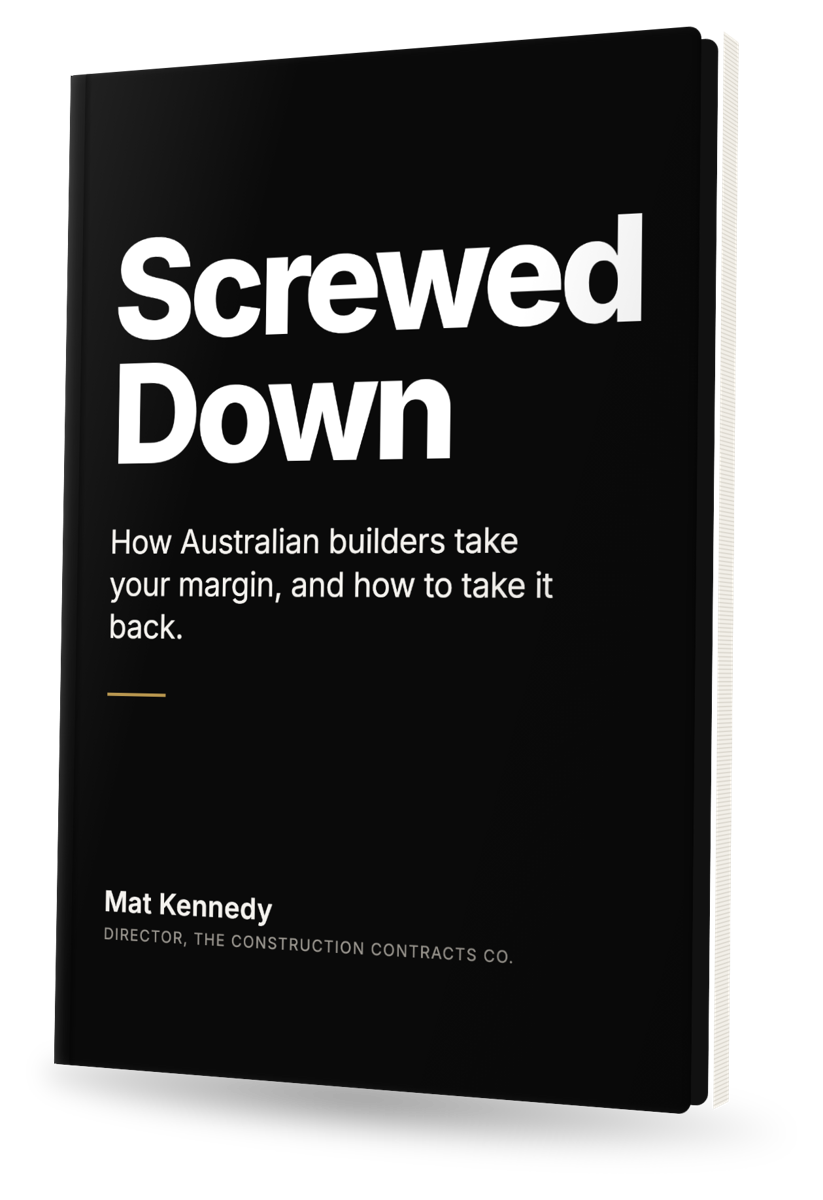
A summary of chapter 8 of Screwed Down by Mat Kennedy. Index figures are as they stood when the book was written (Sept 2026); the live numbers are on the Index. Amazon ranking as seen in September 2026. General information, not legal advice.