
How to review a subcontract in ten minutes: five searches and a checklist
Don't read the whole subcontract, search it. Read the particulars and special conditions first, then search for precedent and bar, liquidated, set off and deduct, release, and Principal and Head Contract. Run what you find against a twelve-line checklist of fair positions.
Chapter 14: Read it in ten minutes
It's 236 pages, it landed at 4:30 on a Friday and the builder wants it signed Monday. You're not going to read it, and neither has the builder's own project manager. So don't read it. Search it. A subcontract is a long document with a small number of load-bearing sentences, and a PDF has a search box. Start with the particulars, three to six pages where the rates, percentages and periods live, then the special conditions, which usually override everything else.
Then five searches. Precedent and bar find every time bar. Liquidated finds the rate, the cap or lack of one, and any head contract flow-down, and then you check the completion date is a real date. Set off and deduct find where money gets taken. Release finds the retention triggers, deemed releases and the release form. Principal and Head Contract find every place your entitlement is tied to a contract you haven't seen. With twenty minutes, five more searches cover a security interest over your property, termination for convenience, qualifying causes, the schedule of rates and supply.
What you find goes into a twelve-line anti-screw checklist, with the common position next to the fair one: payment term, time bars, LDs, completion date, set-off, retention, defects, release form, variations, qualifying causes, termination and head contract tethers. More than six fails means negotiate hard or price it. Ten fails tells you what kind of builder you're dealing with.
- 1Read the particulars and special conditions first: half of what matters is on those few pages.
- 2A typical contract has five to eight time bars, each a place where a late email costs you a claim.
- 3Search for PPS: some contracts grant the builder a security interest over all your present and future property.
- 4A subcontract that fails more than six of the twelve checklist items is one to negotiate hard or price accordingly.
Open the subcontract on your desk, or the last one you signed, and run the five searches. Write the results on one page. Then run the twelve-line checklist against it and count the fails. That number is the honest description of the job.
Common questions
What should I look for when reviewing a subcontract?
Start with the particulars and special conditions, then focus on time bars, liquidated damages and the completion date, set-off, retention and release clauses, and anything tied to the head contract. Also check termination for convenience, the qualifying causes of delay and the variation clause. For anything significant, get advice before signing.
How long does it take to review a subcontract?
A full legal review can take hours, but a targeted first pass over the high-risk clauses can generally be done in about ten minutes with a PDF search. It won't catch everything, but it shows whether the contract is one to negotiate, price for or walk away from.
Free guides on this topic
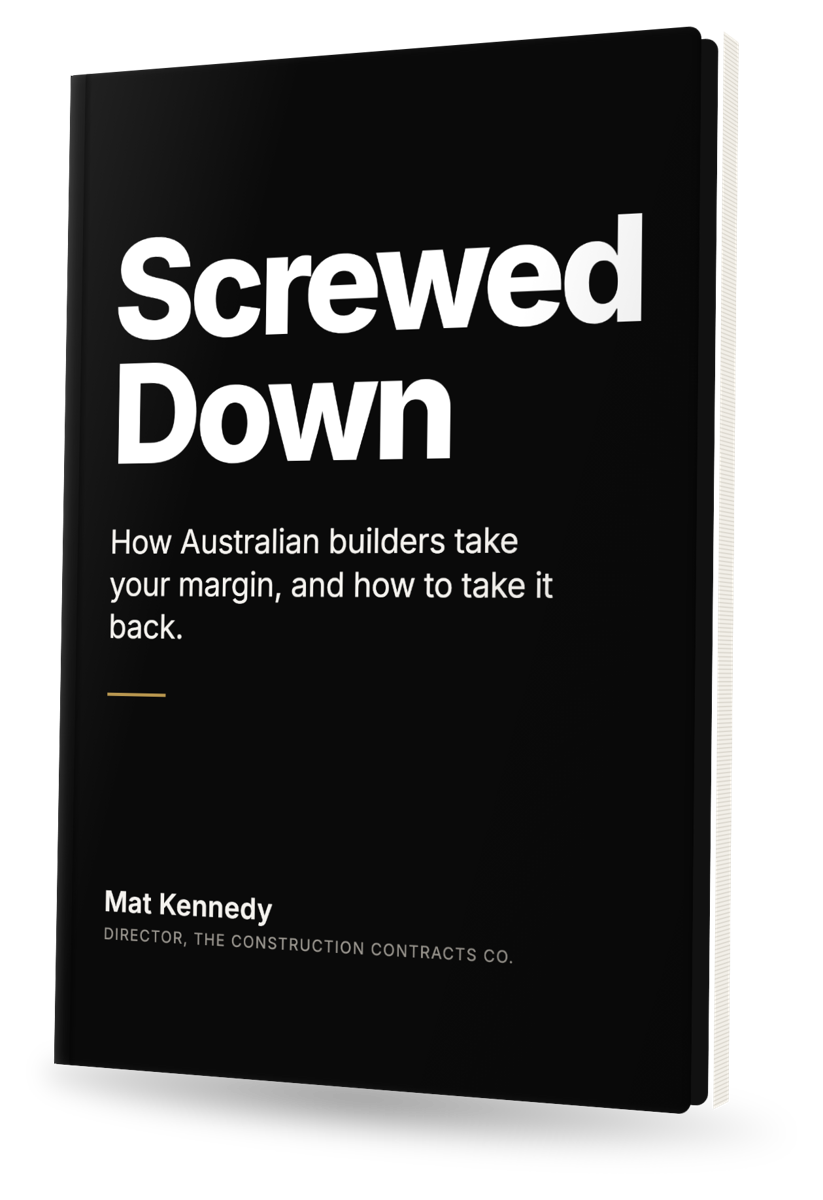
A summary of chapter 14 of Screwed Down by Mat Kennedy. Index figures are as they stood when the book was written (Sept 2026); the live numbers are on the Index. Amazon ranking as seen in September 2026. General information, not legal advice.