
Price the contract, not just the scope: what each subcontract clause costs
Every harsh clause has a cost you can price. On the worst version of a $500,000 package, payment terms, retention, time bars, set-off, LDs, unpaid variations, absorbed exclusions and credit risk add $60,000 to $150,000 that isn't in the drawings. Price it, or negotiate it out before you sign.
Chapter 13: Price the contract, not just the scope
An estimator measures the drawings. A builder's contracts administrator reads the conditions. The gap between those two answers is where your margin goes. Most subbies price the scope and sign the contract, the job runs at 4 per cent instead of the 10 it was tendered at, and everyone blames the site. The site didn't lose the 6 per cent. The contract did, on the day it was signed.
This chapter puts a dollar figure against each clause on a $500,000 package: $6,000 to $10,000 for carrying the builder's money on slow terms, $2,500 of interest on a year's retention, $5,000 to $15,000 of time-bar risk without a notice system, $15,000 to $25,000 of unpaid variations. Uncapped LDs can't be priced as a percentage, so price the capped version and make the cap a condition. Watch provisional sums paid at actual cost with no margin. An electrical subcontractor I worked with lifted its monthly margin by $212,000, and the biggest single change was fixing how provisional sums flowed through claims.
Then align the quote to the subcontract line by line, done by the estimator who knows what the price assumed. Give the foreman a one-page cheat sheet of decision rules. And agree a walk-away number before the tender goes in, because walking away from a losing job is the most profitable call an estimator makes all year.
- 1The worst version of a $500,000 package carries $60,000 to $150,000 of clause cost and risk: twelve to thirty per cent.
- 2A provisional sum replaced by actual cost means that section of the job runs at zero margin.
- 3Credit risk from a builder with a default on file is worth two to three per cent, or $10,000 to $15,000 on $500,000.
- 4The 6 per cent between a job tendered at 10 and landed at 4 is $30,000 on a $500,000 package.
Take the tender you're working on. Next to the price, write eight lines: payment terms, retention, time bars, set-off, LDs, variations, exclusions and credit. Put a dollar figure or a departure against each. If they add up to more than your margin, you haven't finished pricing the job.
Common questions
How do subcontractors price contract risk into a tender?
Read the conditions at tender, not after award. Estimate the cost of each risky clause, such as slow payment terms, retention, liquidated damages and time bars, and either add it to the price or make a departure a condition of the price. Uncapped exposures are generally better handled by negotiating a cap than by guessing a contingency.
Are provisional sums paid with margin?
It depends on the clause. Some subcontracts say the provisional sum excludes your preliminaries and profit and is replaced by actual cost, which means no margin on that work. Check the wording at tender and ask for provisional sums to be adjusted at cost plus margin, in both the clause and your claim format.
Free guides on this topic
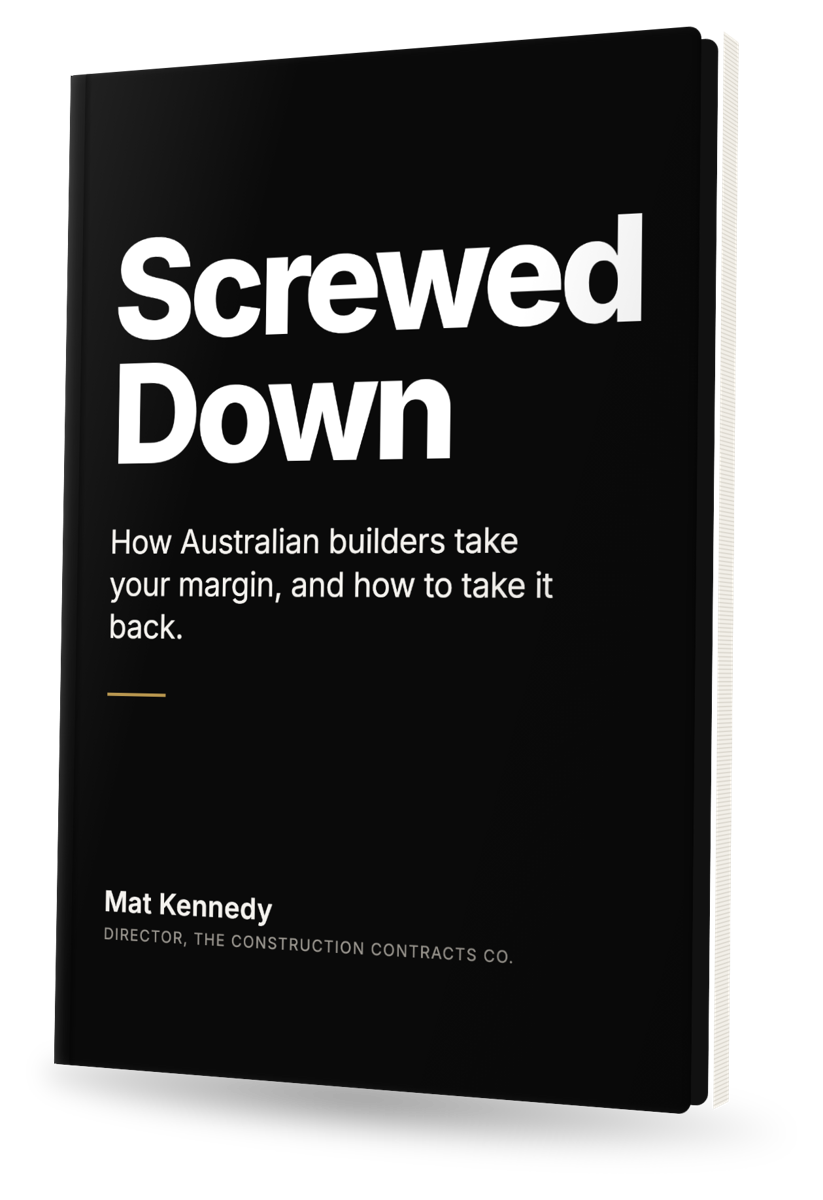
A summary of chapter 13 of Screwed Down by Mat Kennedy. Index figures are as they stood when the book was written (Sept 2026); the live numbers are on the Index. Amazon ranking as seen in September 2026. General information, not legal advice.