
Retention and deeds of release: how 5 per cent for a year becomes five years
Retention usually comes back in two halves, but many subcontracts tie both to the head contract, restart the defects period on every fix, and require a deed of release that gives up all claims. Negotiate release against your own completion and carve disputed claims out of the release form.
Chapter 6: Your money, their account
Retention is the clause every subbie thinks they understand: 5 per cent held, half back at practical completion, half at the end of the defects period. Read the whole clause and it's four mechanisms working together. The first-half trigger is often completion of the head contract, not your work, so a concreter who finishes in month four of a twenty-month tower waits sixteen months. The defects period can also run from head contract completion, and restart every time you fix something.
On the $1.2 million façade contract, stacking those clauses held $59,915 of retention, interest free, into 2032 on a job that took six months. Add a recourse clause that lets the builder take the cash on a mere claim, and a top-up clause making you replace it within ten business days. Then comes the release form. It gets signed in a ute outside the site office: a subbie with $38,000 of disputed variations signs away every claim to get $22,000 of his own money back.
The ask is specific: half released within ten business days of completion of your works, the balance at the end of a 24-month defects period from your completion, rectified items only, an absolute end date, no top-up and no deemed releases. If the release form still says all claims, write the exclusions on it by hand above your signature. And retention itself moves: I once told a major builder that 10 per cent was crazy, laid out five questions in an email, and we settled at 5.
- 1Many subcontracts release the first half of retention at practical completion of the head contract, not your own completion.
- 2Restarting defects periods and a release twelve months after the final certificate held $59,915 on the façade contract into 2032.
- 3A deed of release covering all claims can wipe out disputed variations, notified delay costs and unresolved set-off.
- 4In New South Wales, on a head contract of $20 million or more, the builder must hold your retention in a trust account.
Read the release form in your current subcontract's schedules. If it releases all claims, write your carve-out now and stick it inside the front cover: excluding claims notified in writing before this date, retention, amounts certified but unpaid, and rights under the Act.
Common questions
Should I sign a deed of release to get my retention back?
Read it first. Many release forms give up all claims up to completion, including disputed variations and delay costs. Generally you can carve out claims notified in writing, retention, certified but unpaid amounts and your rights under the security of payment Act. If in doubt, get advice before signing anything that releases claims.
When should a subcontractor get retention back?
It depends on the contract. Commonly half comes back at practical completion and half at the end of the defects liability period, but many subcontracts measure both from the head contract rather than your work. In New South Wales, retention on head contracts of $20 million or more must be held in trust. Check your contract and state rules.
Free guides on this topic
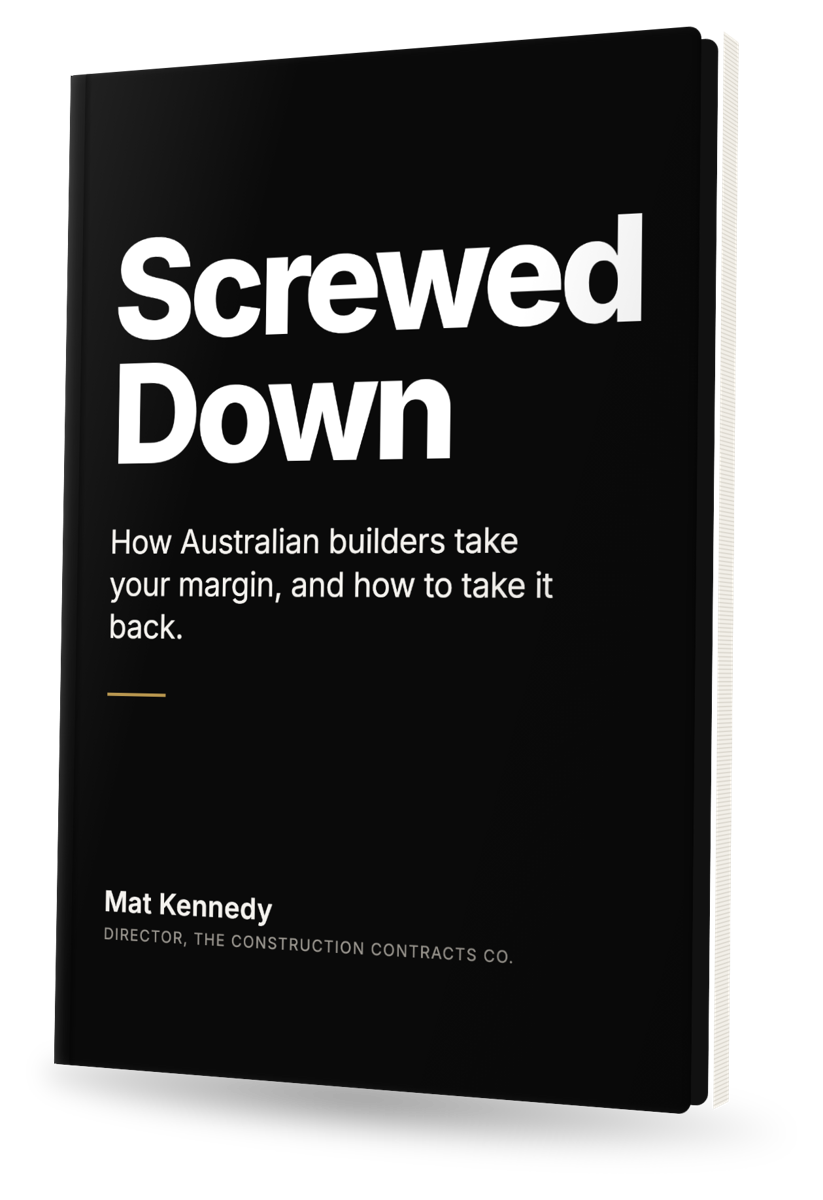
A summary of chapter 6 of Screwed Down by Mat Kennedy. Index figures are as they stood when the book was written (Sept 2026); the live numbers are on the Index. Amazon ranking as seen in September 2026. General information, not legal advice.